Which ASIC Miner Delivers the Best J/TH Efficiency in 2024?
Energy costs can make or break your mining operation. A single percentage point difference in efficiency translates to thousands of dollars over a year of continuous operation. That’s why J/TH (joules per terahash) has become the single most important specification when evaluating hardware purchases in 2024.
The best ASIC miner efficiency 2024 leaders include the Antminer S21 Pro at 15 J/TH and the WhatsMiner M60S at 16.5 J/TH. Choosing efficient hardware reduces electricity costs by 30-40% compared to older models, directly impacting profitability. Efficiency ratings, hashrate, upfront cost, and your electricity rate determine ROI. Modern miners pay for themselves 6-12 months faster than previous generation equipment when electricity exceeds $0.08/kWh.
Understanding J/TH and why it matters more than hashrate
Hashrate tells you how fast a miner works. Efficiency tells you how much it costs to run.
J/TH measures how many joules of electricity your miner consumes to produce one terahash of computing power. Lower numbers mean better efficiency. A miner running at 15 J/TH uses 15% less power than one at 17.5 J/TH while producing the same hashrate.
Here’s the math that matters. If you’re running a 100 TH/s miner at 15 J/TH, you consume 1,500 watts. That same hashrate at 25 J/TH pulls 2,500 watts. Over a month of continuous operation at $0.10/kWh, the efficient model costs $108 in electricity while the inefficient one costs $180. That’s $864 extra per year, per machine.
Scale this across a 100-miner operation and you’re looking at $86,400 in annual savings.
The efficiency gap matters even more when Bitcoin’s price drops or mining difficulty increases. Efficient miners stay profitable longer. They’re the last ones standing when margins get tight.
Top efficiency champions in 2024
Several manufacturers pushed efficiency boundaries this year. Here are the models setting new standards.
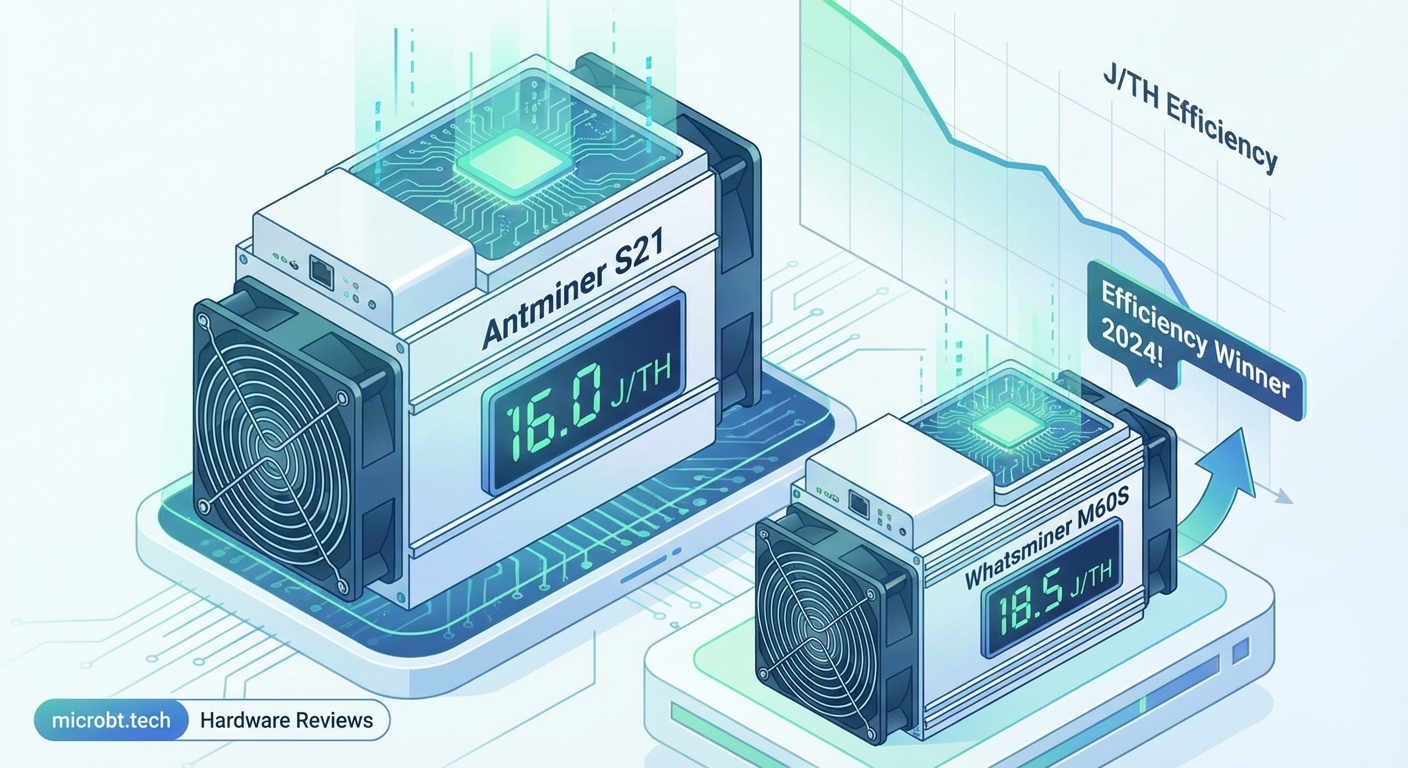
Bitmain Antminer S21 Pro leads the pack at 15 J/TH with 234 TH/s hashrate. It draws 3,510 watts and represents the current efficiency ceiling for SHA-256 mining. Units shipped in Q1 2024 and have maintained stable performance across diverse operating environments.
MicroBT WhatsMiner M60S delivers 16.5 J/TH at 186 TH/s, consuming 3,100 watts. It costs less upfront than the S21 Pro while offering respectable efficiency. This model works well for operators with moderate electricity rates between $0.06 and $0.10/kWh.
Canaan Avalon A1466 hits 18.5 J/TH at 150 TH/s with 2,775 watts power draw. It’s a solid mid-tier option that balances initial investment against operating costs. Availability has been better than competitors throughout 2024.
Antminer S21 (non-Pro version) operates at 17.5 J/TH with 200 TH/s and 3,500 watts consumption. It offers a lower entry price than the Pro model with only slightly reduced efficiency.
WhatsMiner M50S++ runs at 22 J/TH with 146 TH/s at 3,276 watts. While not the most efficient, it remains profitable in regions with electricity under $0.07/kWh and has proven reliability over extended operation.
Efficiency comparison across manufacturers
| Model | J/TH | Hashrate (TH/s) | Power (W) | Release Date |
|---|---|---|---|---|
| Antminer S21 Pro | 15.0 | 234 | 3,510 | Q1 2024 |
| WhatsMiner M60S | 16.5 | 186 | 3,100 | Q2 2024 |
| Avalon A1466 | 18.5 | 150 | 2,775 | Q1 2024 |
| Antminer S21 | 17.5 | 200 | 3,500 | Q4 2023 |
| WhatsMiner M50S++ | 22.0 | 146 | 3,276 | Q3 2023 |
The efficiency leaders share common characteristics. They use advanced chip manufacturing processes (5nm or 7nm), implement optimized cooling systems, and feature firmware that balances performance against power consumption.
Bitmain has historically led efficiency races, but MicroBT closed the gap significantly in 2024. Canaan remains competitive in the mid-tier segment where price-conscious buyers operate.
Calculating real-world profitability based on efficiency
Efficiency numbers mean nothing without context. Your electricity rate determines which miners make financial sense.
Here’s how to calculate daily profit for any miner:
- Find your miner’s daily Bitcoin production using current difficulty and hashrate
- Multiply Bitcoin earned by current BTC price to get daily revenue
- Calculate daily electricity cost (power consumption in kW × 24 hours × your rate)
- Subtract electricity cost from revenue to get daily profit
Let’s run actual numbers for the Antminer S21 Pro at different electricity rates.
At $0.05/kWh with Bitcoin at $40,000 and current difficulty, the S21 Pro generates roughly $18.50 daily revenue. Electricity costs $4.21 daily. Net profit: $14.29 per day.
At $0.10/kWh, electricity doubles to $8.42. Net profit drops to $10.08 daily. That’s a 29% reduction in profit from a 100% increase in electricity cost.
At $0.15/kWh, electricity hits $12.63. Net profit: $5.87 daily. You’re earning 59% less than the $0.05/kWh scenario.
Now compare this to a WhatsMiner M50S++ at 22 J/TH running under the same conditions.
At $0.05/kWh: $11.60 revenue, $3.93 electricity, $7.67 net profit.
At $0.10/kWh: $11.60 revenue, $7.86 electricity, $3.74 net profit.
At $0.15/kWh: $11.60 revenue, $11.79 electricity, negative $0.19 net profit.
The inefficient miner becomes unprofitable at $0.15/kWh while the efficient S21 Pro still generates nearly $6 daily. This gap compounds over months and years.
The miners that survive bear markets aren’t the ones with the highest hashrate. They’re the ones with the lowest J/TH. Efficiency is your insurance policy against volatility.
Factors beyond efficiency that affect your bottom line
J/TH isn’t the only number that matters. Several other factors influence total cost of ownership.
Upfront cost varies wildly. The S21 Pro commands premium pricing, often $3,000-$4,000 more than mid-tier alternatives. You need to calculate how long efficiency savings take to recover that price difference.
Reliability and warranty impact long-term costs. A miner that fails after 8 months destroys your ROI regardless of efficiency. Bitmain and MicroBT offer 180-day warranties. Canaan provides similar coverage. Factor in potential repair costs and downtime.
Noise levels matter for home miners or small operations. The S21 Pro runs at approximately 75 dB. That’s loud enough to require dedicated space away from living areas. Some operators accept slightly lower efficiency for quieter operation.
Heat output correlates directly with power consumption. A 3,500-watt miner produces 3,500 watts of heat. You’ll need adequate ventilation or cooling, which adds to operating costs. Hot climates may require additional HVAC expenses that offset efficiency gains.
Firmware and optimization capabilities let you tune performance. Some miners allow underclocking to improve efficiency at the cost of hashrate. This flexibility helps during low-profitability periods.
Common mistakes when choosing efficient miners
Many buyers focus exclusively on J/TH ratings and miss critical context.
Mistake 1: Buying the most efficient miner regardless of price. If a 15 J/TH miner costs $8,000 and a 17.5 J/TH model costs $4,500, the efficiency difference might not justify the premium. Calculate break-even periods before committing.
Mistake 2: Ignoring total hashrate in favor of efficiency. A 15 J/TH miner producing 100 TH/s generates less revenue than a 17 J/TH miner producing 200 TH/s. You need to balance both metrics.
Mistake 3: Assuming efficiency ratings reflect real-world performance. Manufacturers test under ideal conditions. Actual efficiency varies based on ambient temperature, altitude, power quality, and firmware settings. Expect 5-10% variance from spec sheets.
Mistake 4: Overlooking power supply efficiency. Your PSU converts AC to DC with some loss. A 90% efficient PSU adds 10% to your actual power consumption. Factor this into calculations.
Mistake 5: Buying based on current profitability without considering difficulty adjustments. Mining difficulty increases roughly every two weeks. What’s profitable today might be marginal in six months. Efficient miners maintain profitability longer as difficulty rises.
How electricity rates change the efficiency equation
Your location determines which miners make sense. Different rate structures favor different hardware.
- Rates under $0.05/kWh: Nearly any modern miner remains profitable. You can consider older models with 25-30 J/TH if upfront costs are significantly lower.
- Rates $0.05-$0.08/kWh: Target miners under 20 J/TH. This is the sweet spot where efficiency starts mattering significantly.
- Rates $0.08-$0.12/kWh: Only consider miners under 18 J/TH. Efficiency becomes critical to maintaining positive margins.
- Rates above $0.12/kWh: Stick to the most efficient models (15-16 J/TH). Anything less efficient risks becoming unprofitable during difficulty increases or price dips.
Some operators access tiered pricing where rates change based on consumption levels or time of day. If you can run miners during off-peak hours at reduced rates, you expand your viable hardware options.
Industrial operations often negotiate special rates below $0.05/kWh through long-term contracts or by locating near power generation facilities. At these rates, efficiency matters less than maximizing hashrate density per square foot.
Efficiency trends and what’s coming in 2025
Manufacturers continue pushing efficiency boundaries, but we’re approaching physical limits.
The jump from 25 J/TH (2022 models) to 15 J/TH (2024 leaders) represents a 40% efficiency improvement in two years. That pace won’t continue indefinitely.
Chip manufacturing processes are approaching atomic-scale limitations. Moving from 7nm to 5nm to 3nm yields diminishing returns. Each process shrink costs exponentially more while delivering smaller efficiency gains.
Expect 2025 models to hit 13-14 J/TH at the high end. That’s roughly a 10% improvement over current leaders. Meaningful but not revolutionary.
The next major efficiency leap will likely come from architectural innovations rather than smaller chips. Some manufacturers are experimenting with immersion cooling, which allows chips to run at higher efficiency by maintaining lower temperatures.
Other promising developments include dynamic frequency scaling that adjusts power consumption based on Bitcoin price and difficulty, maximizing profit rather than raw hashrate.
Making the efficiency decision for your operation
Choosing the right miner requires matching hardware to your specific situation.
Start by calculating your all-in electricity cost including distribution charges, demand fees, and taxes. Many miners look only at the base kWh rate and underestimate true costs by 20-30%.
Determine your budget for both upfront hardware and monthly operating expenses. Build a spreadsheet comparing different models across 12-24 month periods under various Bitcoin price scenarios.
Consider your technical capabilities. More efficient miners often require more sophisticated cooling and power delivery. Make sure your facility can support the equipment.
Think about your time horizon. If you plan to mine for 2+ years, prioritize efficiency. If you’re speculating on a 6-month operation, upfront cost matters more.
Account for resale value. Efficient miners hold value better than inefficient ones. When you eventually upgrade, you’ll recover more of your initial investment.
Factor in opportunity cost. Money spent on premium-efficiency hardware can’t be used for additional miners or other investments. Sometimes buying two mid-tier miners generates more total profit than one top-tier unit.
Setting up efficient miners for maximum performance
Buying efficient hardware is only half the battle. Proper setup and maintenance ensure you actually achieve rated specifications.
Environmental control: Maintain ambient temperature between 20-30°C. Every 10°C increase above optimal reduces efficiency by approximately 2-3%. Install adequate ventilation to exhaust hot air and bring in cool air.
Power delivery: Use dedicated circuits with appropriate amperage. Voltage fluctuations and dirty power reduce efficiency and shorten hardware lifespan. Consider power conditioning equipment for large operations.
Firmware optimization: Keep firmware updated. Manufacturers release updates that improve efficiency and stability. Some firmware allows custom tuning to balance efficiency and hashrate based on your electricity costs.
Regular maintenance: Clean miners monthly to prevent dust buildup on heatsinks and fans. Dirty equipment runs hotter and less efficiently. Replace thermal paste annually on high-use machines.
Monitoring systems: Install software that tracks power consumption, hashrate, and temperature in real-time. Efficiency degrades gradually, so you need data to catch problems early.
Why efficiency determines long-term mining success
Mining profitability cycles through boom and bust periods. Efficient hardware is your survival tool during downturns.
When Bitcoin prices drop 50%, inefficient miners shut down immediately. Their operating costs exceed revenue. Efficient miners continue generating positive cash flow, accumulating Bitcoin while competitors exit.
This dynamic creates a compounding advantage. Efficient operators mine through bear markets when difficulty drops as inefficient miners shut down. They accumulate more Bitcoin at lower difficulty, then benefit when prices recover.
Historical data shows miners with sub-20 J/TH efficiency maintained profitability through every significant price correction since 2022. Miners above 30 J/TH faced repeated unprofitable periods lasting months.
The efficiency advantage extends beyond electricity savings. Efficient miners generate less heat per terahash, reducing cooling costs. They often use newer chip technology with better reliability. They command higher resale values.
Over a typical 3-year mining hardware lifecycle, a 15 J/TH miner generates 35-45% more profit than a 22 J/TH miner at $0.08/kWh electricity. That gap widens at higher rates and narrows at lower rates, but efficiency always wins long-term.
Your efficiency strategy starts now
The best ASIC miner efficiency 2024 options give you a significant edge, but only if you match hardware to your specific circumstances. Calculate your true electricity costs, model different scenarios, and choose equipment that keeps generating profit even when conditions deteriorate. The miners running three years from now will be the efficient ones bought today.