How to Calculate Your True Mining Profitability Beyond the Basic Numbers
Most online mining calculators show you one number: daily profit. They make it look simple. Plug in your hashrate, hit calculate, and boom. You’re supposedly making $15 per day.
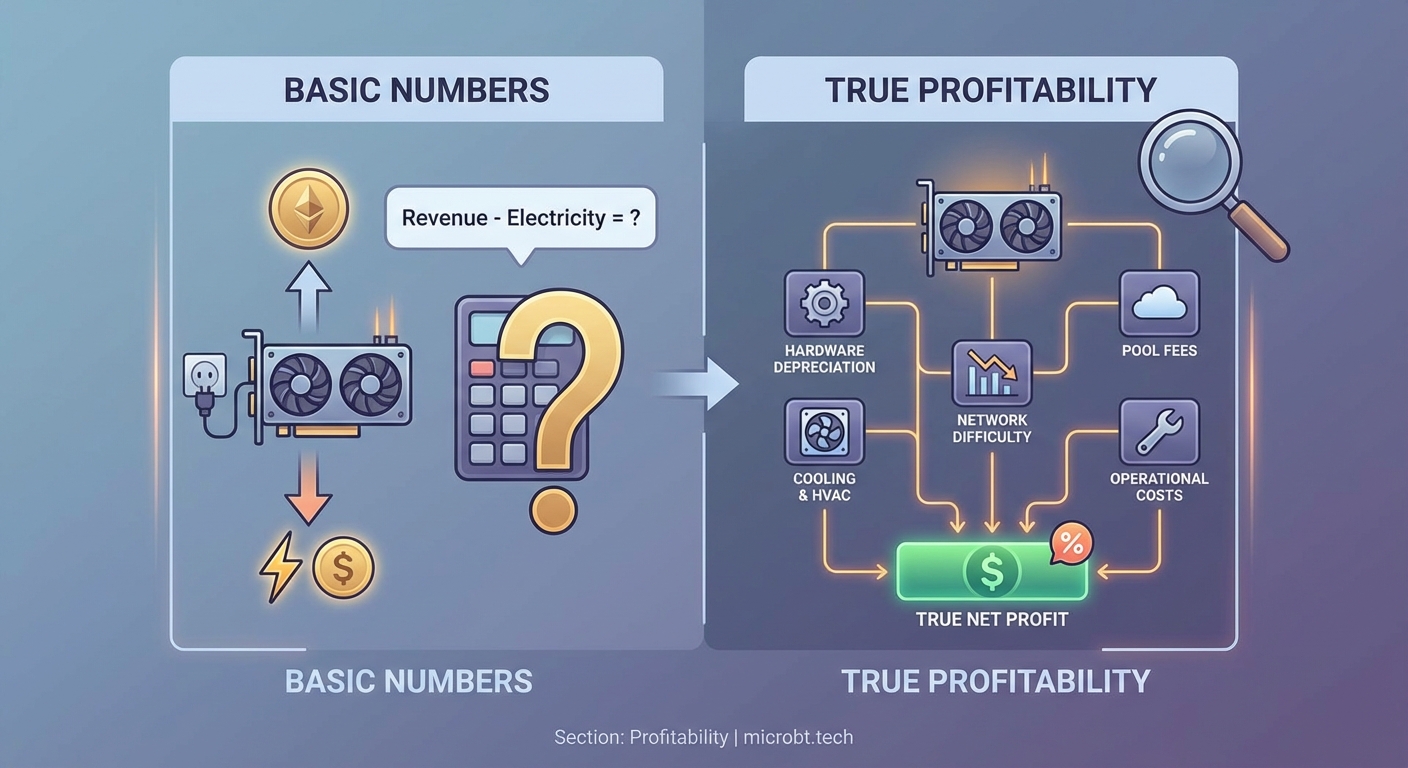
But here’s what those calculators don’t tell you: that $15 becomes $8 after electricity. Then $6 after pool fees. Then $4 after cooling costs. And if your machine breaks down in six months, your “profitable” miner just lost you thousands.
Real mining profitability isn’t a single number. It’s a full picture that includes hardware degradation, difficulty adjustments, price volatility, downtime, and dozens of other factors that basic tools ignore.
Mining profitability requires calculating daily revenue from block rewards and fees, subtracting all operating costs including electricity and cooling, then factoring in hardware depreciation, network difficulty changes, and breakeven timelines. Most miners overestimate profits by 40 to 60 percent because they ignore hidden costs and assume static conditions in a dynamic market.
Understanding the complete cost structure
Before you touch any formula, you need to know every dollar leaving your pocket.
Hardware costs are obvious. You buy an ASIC miner for $3,000 or a GPU rig for $5,000. That’s your capital expenditure, your upfront investment.
But then the monthly bills start rolling in.
Electricity is the biggest ongoing expense. A single Antminer S19 XP running at 3,010 watts consumes about 72 kilowatt hours per day. At $0.10 per kWh, that’s $7.20 daily or $216 monthly. At $0.15 per kWh, it jumps to $324 per month.
Cooling adds another layer. If you’re mining in a garage during summer, you might need fans, ventilation, or even air conditioning. That can add 10 to 30 percent to your electricity bill.
Pool fees typically range from 1 to 3 percent of your mining rewards. Some pools charge more for better payout structures or lower variance.
Then there’s internet, which is usually negligible but still a cost. Replacement parts matter too. Fans fail. Hash boards die. PSU units wear out.
Insurance, if you’re running a serious operation. Rent or mortgage allocation if you’re dedicating space. Taxes on your mining income, which vary wildly depending on your jurisdiction.
Most beginners forget half of these costs. They see “$15 daily profit” and think they’re printing money. Six months later, they’re wondering why their bank account doesn’t match the calculator.
Breaking down the revenue formula
Revenue comes from two sources: block rewards and transaction fees.
For Bitcoin, the current block reward is 3.125 BTC per block after the 2024 halving. The network produces roughly 144 blocks per day. That’s 450 BTC distributed daily across all miners worldwide.
Your share depends on your hashrate relative to the total network hashrate.
Here’s the formula:
Daily BTC Revenue = (Your Hashrate / Network Hashrate) × Daily Block Rewards
Let’s use real numbers. Say you have an Antminer S19 XP with 140 TH/s. The Bitcoin network hashrate is around 600 EH/s (600,000,000 TH/s).
Daily BTC = (140 / 600,000,000) × 450 = 0.000105 BTC per day
At $60,000 per BTC, that’s $6.30 daily revenue.
Transaction fees add a bonus. During high network activity, fees can contribute 10 to 30 percent extra. During quiet periods, they’re negligible.
For Ethereum mining (pre-merge reference) or other proof of work coins, the formula stays the same. Just swap in the relevant block reward and network hashrate.
Most calculators handle this math automatically. The problem is they use current values and assume nothing changes. Network hashrate grows. Difficulty adjusts. Prices fluctuate. Your actual revenue six months from now could be half what the calculator shows today.
Calculating true daily profit
Now we subtract costs from revenue.
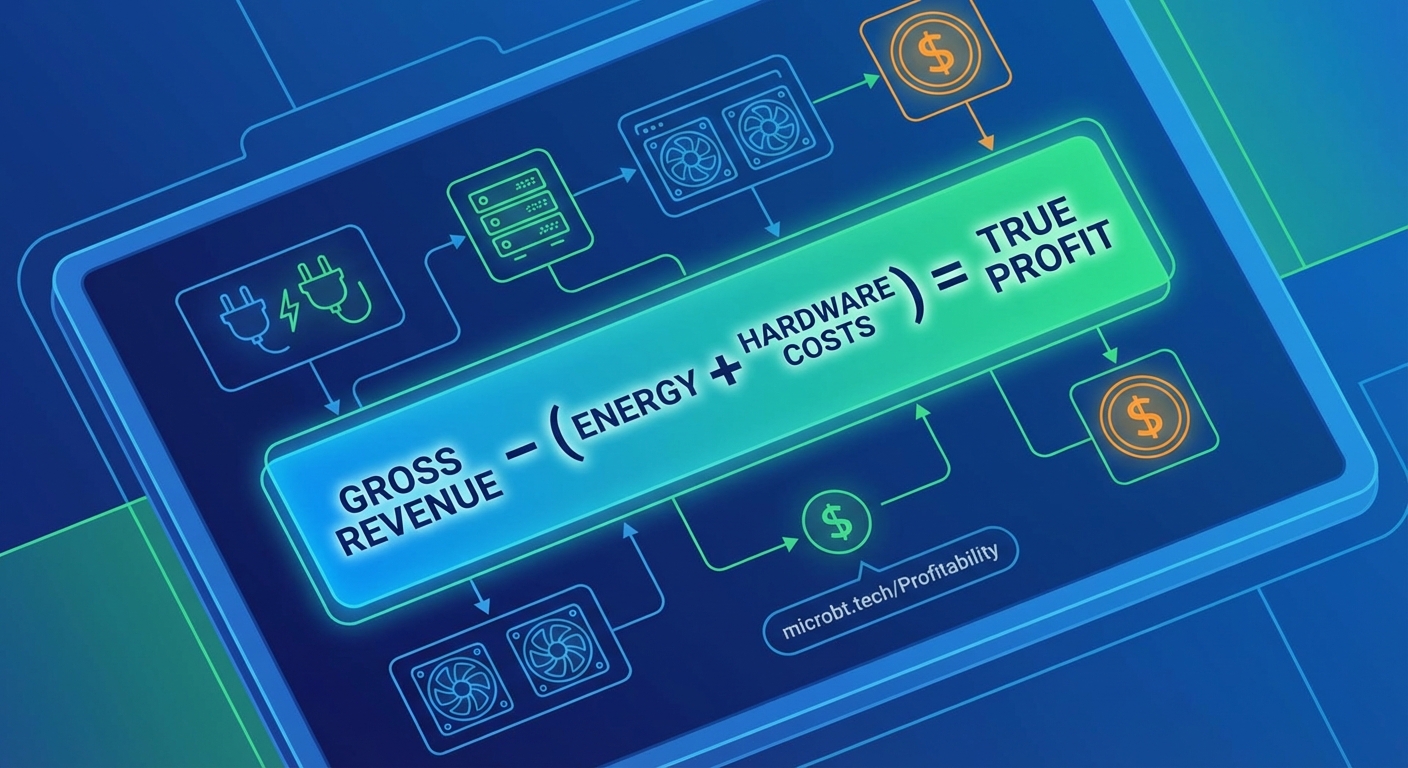
Daily Profit = Daily Revenue – Daily Electricity Cost – Daily Pool Fee – Daily Operational Costs
Using our S19 XP example:
- Daily revenue: $6.30
- Daily electricity (72 kWh × $0.10): $7.20
- Daily pool fee (2% of revenue): $0.13
- Daily cooling and misc (estimated): $0.50
Daily Profit = $6.30 – $7.20 – $0.13 – $0.50 = -$1.53
You’re losing money every single day at $0.10 per kWh with Bitcoin at $60,000.
This is why electricity cost is everything. Drop it to $0.06 per kWh:
Daily electricity: 72 × $0.06 = $4.32
Daily Profit = $6.30 – $4.32 – $0.13 – $0.50 = $1.35
Now you’re profitable, but barely. And that’s before accounting for hardware depreciation.
This is the harsh reality most mining calculators hide. They show gross revenue, not net profit. They assume perfect uptime and ignore the dozen small costs that eat into margins.
Factoring in hardware depreciation
Your mining hardware loses value every month.
A brand new S19 XP might sell for $3,000 today. In 12 months, it might be worth $1,500. In 24 months, maybe $800. Eventually, it becomes e-waste.
This depreciation is a real cost, even though it doesn’t hit your bank account monthly like electricity does.
Here’s how to factor it in:
Monthly Depreciation = (Purchase Price – Estimated Resale Value) / Expected Lifespan in Months
If you bought an S19 XP for $3,000 and expect it to be worth $600 after 24 months:
Monthly Depreciation = ($3,000 – $600) / 24 = $100
Daily Depreciation = $100 / 30 = $3.33
Add that to your daily cost calculation:
True Daily Profit = $1.35 – $3.33 = -$1.98
Suddenly you’re back in the red, even at cheap electricity.
This is why breakeven calculations matter more than daily profit snapshots.
Calculating breakeven and payback period
Breakeven tells you when your cumulative profit equals your initial investment.
Breakeven Time = Total Investment / Average Daily Profit
But remember, daily profit changes constantly. Network difficulty rises. Coin prices swing. Your hashrate might drop as hardware ages.
Let’s build a realistic scenario:
- Initial investment: $3,500 (hardware + setup)
- Average daily profit: $2.50 (optimistic, assuming $0.06 electricity and $65,000 BTC)
- Network difficulty increase: 2% monthly
- Hardware efficiency loss: 1% per quarter
Without difficulty adjustments, breakeven would be:
$3,500 / $2.50 = 1,400 days (about 3.8 years)
But difficulty doesn’t stay flat. If it increases 2% monthly, your revenue drops proportionally. After 12 months, your daily revenue is about 21% lower. Your $2.50 daily profit becomes $1.98.
Run the compound math, and breakeven stretches to 5+ years. By then, your hardware is obsolete and your $3,500 investment is worth maybe $500 in resale.
This is why professional miners focus on ROI timelines under 18 months. Anything longer is too risky given market volatility and technological advancement.
Building a dynamic profitability model
Static calculators fail because mining is dynamic. You need a model that updates with real variables.
Here’s a framework:
Step 1: Set baseline parameters
- Hardware hashrate and power consumption
- Current electricity cost
- Current coin price
- Current network difficulty
- Pool fee structure
- Initial hardware cost
Step 2: Add growth assumptions
- Monthly difficulty increase (historical average: 2-5%)
- Quarterly coin price change (conservative, moderate, optimistic scenarios)
- Annual electricity cost changes
- Hardware efficiency degradation
Step 3: Calculate monthly projections
For each month:
- Adjust difficulty based on growth rate
- Recalculate daily revenue
- Adjust hardware efficiency if applicable
- Calculate net profit
- Add to cumulative total
Step 4: Identify breakeven month
Find when cumulative profit exceeds initial investment.
Step 5: Run sensitivity analysis
What happens if Bitcoin drops 30%? What if difficulty spikes 10% in one month? What if electricity costs rise?
This approach gives you a range of outcomes instead of a single misleading number.
Common calculation mistakes miners make
| Mistake | Why It Hurts | How to Fix |
|---|---|---|
| Using current coin price for long-term projections | Assumes price stays flat; ignores volatility | Model three scenarios: bearish, neutral, bullish |
| Ignoring difficulty adjustments | Overestimates future revenue by 30-50% | Factor in 2-3% monthly difficulty growth minimum |
| Forgetting pool fees | Reduces profit by 1-3% instantly | Include in daily cost calculation |
| Skipping depreciation | Hides true cost of hardware aging | Calculate monthly depreciation and add to costs |
| Assuming 100% uptime | Real operations have 5-15% downtime | Multiply revenue by 0.90 to 0.95 |
| Using manufacturer specs | Real hashrate often 3-5% lower | Use conservative hashrate estimates |
The biggest mistake? Trusting a single calculator without understanding the underlying math. You’re betting thousands of dollars on an algorithm you don’t understand.
Learn the formulas. Build your own spreadsheet. Stress test your assumptions.
Real-world example with full breakdown
Let’s calculate profitability for a realistic home mining setup.
Hardware:
– 1× Antminer S19 XP (140 TH/s, 3,010W)
– Purchase price: $2,800
– Setup costs (PSU, cables, ventilation): $400
– Total investment: $3,200
Operating environment:
– Electricity: $0.08 per kWh
– Pool fee: 2%
– Cooling adds 15% to power consumption
– Internet: $5/month allocated to mining
Network conditions (starting):
– Bitcoin price: $62,000
– Network hashrate: 600 EH/s
– Block reward: 3.125 BTC per block
Daily calculations:
Revenue:
– (140 TH/s / 600,000,000 TH/s) × 450 BTC = 0.000105 BTC
– 0.000105 × $62,000 = $6.51
Costs:
– Base power: 3,010W × 24h = 72.24 kWh
– With cooling: 72.24 × 1.15 = 83.08 kWh
– Electricity: 83.08 × $0.08 = $6.65
– Pool fee: $6.51 × 0.02 = $0.13
– Internet: $5 / 30 = $0.17
– Depreciation: ($3,200 – $500) / 730 days = $3.70
Daily net: $6.51 – $6.65 – $0.13 – $0.17 – $3.70 = -$4.14
You’re losing $4.14 per day. Over a month, that’s $124 in losses.
Now adjust Bitcoin to $75,000:
Revenue: 0.000105 × $75,000 = $7.88
Daily net: $7.88 – $6.65 – $0.16 – $0.17 – $3.70 = -$2.80
Still losing money, but less.
At $90,000 Bitcoin:
Revenue: 0.000105 × $90,000 = $9.45
Daily net: $9.45 – $6.65 – $0.19 – $0.17 – $3.70 = -$1.26
Getting closer, but still underwater.
This illustrates a critical point: at home electricity rates, you need very high coin prices or very cheap power to profit. Most hobbyist miners are actually losing money when you account for all costs.
Advanced considerations for serious miners
Professional operations think beyond daily profit.
They negotiate electricity contracts at $0.03 to $0.05 per kWh. They buy hardware in bulk at discounts. They optimize for efficiency, not just hashrate.
They also consider:
Heat reuse: Can you heat your home or greenhouse with mining waste heat? That offsets heating costs and improves effective profitability.
Demand response programs: Some utilities pay you to shut down during peak demand. This can add $50 to $200 per month.
Firmware optimization: Custom firmware can increase efficiency by 5 to 10 percent, reducing power costs without sacrificing hashrate.
Geographic arbitrage: Moving operations to regions with cheap hydroelectric or geothermal power can cut electricity costs by 60 percent.
Tax strategy: Mining income is taxed differently than capital gains in many jurisdictions. Proper accounting can save thousands.
“The difference between a profitable miner and a broke one isn’t the hardware. It’s understanding every line item in the cost structure and optimizing relentlessly. Most people quit mining not because it’s unprofitable, but because they didn’t calculate profitability correctly in the first place.” — Mining operation manager with 15+ MW capacity
Tools and resources for accurate calculations
You don’t need to build everything from scratch.
Start with established calculators:
– WhatToMine (supports multiple algorithms and coins)
– NiceHash calculator (includes marketplace rates)
– ASIC Miner Value (tracks hardware prices and profitability)
– CoinWarz (historical difficulty and price data)
But don’t stop there. Export the data into a spreadsheet.
Build a model with:
– Monthly revenue projections
– Difficulty growth assumptions
– Price scenarios
– Cost tracking
– Cumulative profit calculations
Update it monthly with actual results. Compare projections to reality. Adjust your assumptions.
Track your real electricity usage with a power meter. Don’t trust manufacturer specs. Measure actual consumption.
Monitor pool payouts daily. Calculate your effective hashrate. If it’s consistently lower than expected, investigate.
Join mining communities. Reddit’s r/BitcoinMining, Bitcointalk forums, and Discord servers have experienced miners sharing real numbers and strategies.
When the math says don’t mine
Sometimes the honest answer is: don’t do it.
If your electricity is above $0.12 per kWh and you’re mining Bitcoin at home, the math probably doesn’t work. You’d be better off just buying Bitcoin directly.
If you can’t afford to lose your entire hardware investment, don’t mine. Treat it like any speculative investment. Only risk what you can afford to lose.
If you’re chasing quick returns, mining isn’t for you. Breakeven timelines of 12 to 24 months are standard. Anything promising faster payback is either lying or operating in very specific conditions you probably can’t replicate.
If you don’t have cheap electricity access, consider:
– Cloud mining (though most are scams; research extensively)
– Mining hosting services (you own hardware, they provide power and space)
– Simply buying and holding the cryptocurrency
Mining isn’t magic money. It’s a business with thin margins, high competition, and constant pressure from difficulty increases and market volatility.
Making your first calculation count
You now have the framework to calculate real mining profitability.
Start with your specific situation. Get your exact electricity rate from your utility bill. Research current hardware prices from multiple vendors. Check today’s network stats for your chosen coin.
Build a simple spreadsheet with daily, monthly, and yearly projections. Include every cost we’ve covered. Be conservative with revenue estimates and realistic with expense projections.
Run three scenarios: worst case (coin price drops 40%, difficulty increases 5% monthly), base case (modest price growth, 2% difficulty increases), and best case (strong bull market, 3% difficulty growth).
If two out of three scenarios show you profitable within 18 months, you might have a viable plan. If all three show losses or breakeven beyond 24 months, reconsider.
The goal isn’t to talk yourself into mining. It’s to make an informed decision with accurate numbers. Calculate honestly, plan conservatively, and mine profitably.