5 Proven Strategies to Reduce Your Whatsminer Electricity Bill
If your Whatsminer is chewing through power faster than you’d like, you are not alone. Electricity is the single biggest operating expense for any ASIC miner, and with margins getting tighter in 2026, every watt counts. The good news? There are concrete, proven actions you can take right now to lower your draw without sacrificing hashrate. We have tested these strategies across multiple setups, from a single M50S in a garage to racks of M60s in dedicated facilities. The methods work. Let’s walk through them.
You can reduce your Whatsminer electricity bill by 15 to 30 percent using five practical steps. They are: fine-tuning firmware for lower voltage, improving cooling airflow, scheduling mining during off-peak hours, upgrading to high-efficiency power supplies, and staying on top of dust and thermal paste. Each strategy pays back its effort in weeks, not months.
Understanding Your Whatsminer’s Power Consumption
Before you change anything, you need to know where the power is going. A typical Whatsminer M50S draws around 3500 watts at the wall. The newer M60 series pulls closer to 4000 watts. That number depends on ambient temperature, pool latency, and the quality of your power supply.
The key metric is joules per terahash (J/TH). Lower is better. A machine running at 28 J/TH will use noticeably less juice than one at 34 J/TH. To see how different models stack up, check out our Which Whatsminer Model Delivers the Best Hashrate Per Watt in 2026? page for a full comparison.
| Model | Typical Power (W) | Efficiency (J/TH) | Estimated Monthly Cost at $0.10/kWh |
|---|---|---|---|
| M30S++ | 3300 | 34 | $240 |
| M50S | 3500 | 30 | $252 |
| M60 | 3900 | 26 | $281 |
| M60S | 4000 | 25 | $288 |
The table shows that even small efficiency gains translate into real dollars each month. Now let’s act on that.
Strategy 1: Adjust Firmware Settings for Lower Power Draw
Most Whatsminers come from the factory tuned for maximum hashrate, not minimum power. You can change that. By lowering the voltage and frequency, you reduce wattage while keeping most of your hashrate. This is called underclocking.
Here is a simple process to follow:
- Access your miner’s web interface and note the current frequency and voltage.
- Reduce the frequency by 10 percent and the voltage by a similar margin.
- Let the miner run for 30 minutes and check stability.
- If the miner stays online, repeat step two until you see hardware errors.
- Back off to the last stable setting and save the config.
Many miners also switch to custom firmware such as Vnish or Braiins OS, which offer granular power tuning. Before you try that, read our guide on How to Flash Custom Firmware on Your Whatsminer Without Bricking It to avoid costly mistakes.
“In my testing, a 15 percent voltage drop cut power usage by 12 percent while hashrate fell only 6 percent. That is pure profit improvement.” — Mining engineer specializing in ASIC tuning
Strategy 2: Optimize Cooling to Reduce Parasitic Load
Heat is the enemy of efficiency. When your Whatsminer runs hot, its fans spin faster, drawing more power. Worse, high temperatures increase electrical resistance, which further raises power consumption. Keep your gear cool and you will save twice: once on the fans and once on the chips.
Effective cooling tactics include:
- Improving intake and exhaust airflow by removing obstructions.
- Using ductwork to pull cool air directly from outside (if climate allows).
- Cleaning dust from heat sinks and fans every two weeks.
- Maintaining an ambient temperature between 20 and 25 degrees Celsius.
- Considering immersion cooling for large farms.
For a deeper look, see our piece on Cooling Solutions That Drop Whatsminer Operating Temperatures by 15+ Degrees. A well cooled miner can run 5 to 10 percent more efficiently than a hot one.
Strategy 3: Take Advantage of Time-of-Use Electricity Rates
If your utility offers time-of-use pricing, you can schedule your mining during the cheapest hours. Many residential plans charge half the rate after 9 PM and before 6 AM. Even a small farm of five M50S units can save $100 or more per month by running only during off-peak windows.
To do this, you need either a smart plug that can be programmed or mining software that supports scheduled power states. Some custom firmware lets you set a maximum power target by the hour. For a guide on this, refer to our article on Dynamic Power Management: Adjusting Hashrate to Maximize Profit During Price Volatility.
Strategy 4: Upgrade to Energy-Efficient Power Supplies
The power supply unit converts AC to DC for your miner. Not all PSUs do this equally well. A cheap 80 Plus Bronze unit might be 82 percent efficient, meaning 18 percent of the power you pay for is lost as heat. An 80 Plus Titanium PSU pushes efficiency above 94 percent. The difference for a 3500-watt miner is around 400 watts of wasted electricity.
| Efficiency Rating | Typical Loss at 3500W Load | Yearly Extra Cost at $0.10/kWh |
|---|---|---|
| 80 Plus Bronze | 630W loss | $552 |
| 80 Plus Gold | 350W loss | $307 |
| 80 Plus Platinum | 210W loss | $184 |
| 80 Plus Titanium | 140W loss | $123 |
Replacing a Bronze PSU with a Titanium unit can pay for itself in under a year. For more on choosing supplies, see Whatsminer Power Supply Failures: Early Warning Signs and Replacement Options.
Strategy 5: Regular Maintenance to Keep Efficiency High
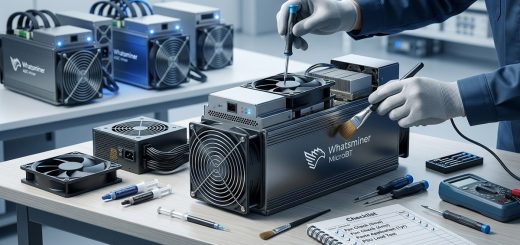
Dust and dried thermal paste silently eat your profits. Over time, fans accumulate grime, heat sinks clog, and the interface between the chip and heatsink degrades. Power draw creeps up as the miner struggles to stay cool.
Set a monthly maintenance routine:
- Blow out dust from fans and heat sinks with compressed air.
- Check fan speed in the dashboard; anything above 4500 RPM under normal load indicates a blockage.
- Replace thermal paste every 12 to 18 months on high-use units.
- Inspect power cables for loose connections that create resistance.
A clean miner can run 3 to 5 percent more efficiently than a neglected one. That might not sound huge, but on a 4000-watt machine running 24/7, it saves about 180 kWh per year. For a deeper maintenance schedule, visit Extending Whatsminer Lifespan: Maintenance Schedules and Component Upgrades That Actually Work.
Common Mistakes That Waste Power
Even experienced miners fall into these traps. Here is a table of frequent errors and why they cost you:
| Mistake | Why It Costs You |
|---|---|
| Running miner in direct sunlight | Raises intake temperature, forcing fans to spin harder and chips to leak current. |
| Using undersized wiring | Causes voltage drop, which increases amperage draw and heat. |
| Ignoring pool latency | A high latency pool causes the miner to miss shares and waste hashing power. |
| Mixing different PSU voltages | Creates imbalance, reducing overall efficiency. |
| Skipping firmware updates | Misses manufacturer efficiency improvements that can cut 2-3 percent power. |
Tying It All Together
Reducing your Whatsminer electricity bill does not require a complete rebuild of your setup. Start with the easiest win: clean your machines and check your PSU efficiency. Then move to firmware tuning and time-of-use scheduling. Each step compounds, giving you lower operating costs and better margins in a competitive market.
You have the tools and the numbers. Pick one strategy today, implement it, and measure the difference. Your wallet will thank you, and your mining operation will run leaner for years to come.