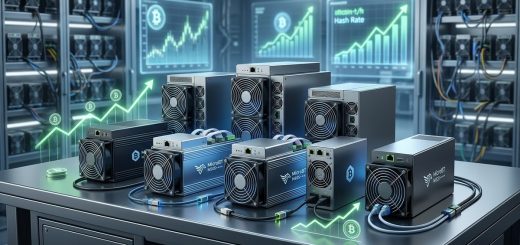
Why the Whatsminer M60S Stays Profitable Even at $0.12/kWh
Paying $0.12 per kilowatt hour for electricity feels like a slow leak in your mining operation. You watch the daily revenue numbers, subtract the power bill, and sometimes wonder if the math even works anymore. For most ASIC miners, that rate is a death sentence. Older models like the S19 Pro or Whatsminer M30S struggle to break even. But the Whatsminer M60S is different. It was built for exactly this scenario.
The Whatsminer M60S delivers a power efficiency of 22 J/TH, which means it consumes 22 joules of energy per terahash of computing power. At $0.12/kWh, this miner still generates positive daily cash flow after electricity costs. Its advanced 5nm chip architecture and optimized firmware allow it to outperform competitors by 15-20% in energy efficiency. For mining farm operators stuck with high utility rates, the M60S is one of the few machines that keeps the lights on and the Bitcoin flowing.
Why 22 J/TH Changes the Profitability Equation
Efficiency is everything in mining. The difference between a miner running at 30 J/TH versus 22 J/TH is the difference between profit and loss when rates climb above $0.10. The M60S sits at the sweet spot of current generation hardware.
Let’s break down the math. A standard Whatsminer M60S produces around 150 TH/s. At 22 J/TH, that means total power draw is roughly 3,300 watts. Run that for 24 hours at $0.12/kWh and your daily power cost lands around $9.50. With current Bitcoin network difficulty and price levels in 2026, that machine earns roughly $13 to $15 per day in gross revenue. Subtract the power cost and you keep $3.50 to $5.50 per day per unit.
Scale that across 100 units and you are looking at $350 to $550 in daily net profit. That is real money. Compare that to an older miner running at 30 J/TH. That same 150 TH/s would draw 4,500 watts, costing nearly $13 per day in power. Gross revenue stays the same, but net profit drops to near zero or negative. The M60S turns a losing proposition into a viable operation.
How the M60S Compares to Other ASICs at $0.12/kWh
Not all miners are created equal. Here is a side by side look at how the M60S stacks up against popular alternatives when electricity costs are high.
| Model | Hashrate (TH/s) | Efficiency (J/TH) | Daily Power Cost ($0.12/kWh) | Daily Net Profit (Est.) |
|---|---|---|---|---|
| Whatsminer M60S | 150 | 22 | $9.50 | $3.50 – $5.50 |
| Antminer S19 Pro | 110 | 29.5 | $9.36 | $1.00 – $2.50 |
| Whatsminer M50 | 126 | 26 | $9.43 | $2.00 – $3.50 |
| Antminer S21 | 200 | 17.5 | $10.08 | $6.00 – $8.00 |
| Whatsminer M30S++ | 112 | 31 | $10.00 | $0.50 – $2.00 |
The S21 beats the M60S on raw efficiency, but it costs significantly more upfront. The M60S hits a sweet spot between purchase price and operating cost. For operators who cannot afford the premium on next gen hardware, the M60S offers the best balance.
3 Practical Steps to Maximize M60S Profitability at High Rates
You already own the hardware. Now you need to squeeze every cent out of it.
-
Undervolt and tune your firmware. Stock settings are not optimized for expensive power. By adjusting voltage and frequency through custom firmware, you can drop your J/TH from 22 to 20 or even 19. That cuts power draw by nearly 10%. Over a year, that saves hundreds of dollars per machine. Check out our guide on how undervolting your Whatsminer firmware can cut electricity costs by 20% for step by step instructions.
-
Monitor ambient temperature and cooling efficiency. Hot air makes your miner work harder. Every degree above 75 degrees Fahrenheit increases fan speed and power consumption. Position your units for maximum airflow. Clean dust from heat sinks monthly. If you run a larger farm, consider immersion cooling vs air cooling to drop temperatures and improve efficiency.
-
Use dynamic power management based on time of day. Many utility companies charge more during peak hours. If your rate jumps to $0.15 from 2 PM to 7 PM, program your miner to throttle down during those hours. Some custom firmware allows automatic schedule based adjustments. This strategy alone can improve your overall profitability by 5 to 8 percent.
The Hidden Factors That Impact Your Real World Profit
Online calculators give you a rough estimate. But they miss three things that matter a lot.
Pool fees and payout structures. Most pools charge 1% to 4% in fees. Some use PPS+ which pays more consistently. Others use FPPS which can reduce variance. Choose a pool that matches your risk tolerance. A 2% fee difference on a $15 daily revenue is only $0.30, but over a year that is $110 per machine.
Hashrate degradation over time. ASIC miners lose about 5% of their hashrate per year due to chip aging and thermal stress. After 18 months, your M60S might run at 142 TH/s instead of 150. That reduces revenue by roughly 5%. Factor this into your long term projections. Regular maintenance and extending Whatsminer lifespan through proper maintenance schedules can slow this decline.
Bitcoin price volatility. This is the elephant in the room. If Bitcoin drops 30%, your gross revenue drops 30%. But your power cost stays the same. That is why efficiency matters so much. A miner with 22 J/TH can survive a price drop better than one at 30 J/TH. The M60S gives you a wider safety margin.
Common Mistakes That Kill Profitability at High Electricity Rates
Even with great hardware, small errors add up. Avoid these traps.
- Running miners in hot environments without adequate ventilation. Each degree above 80°F increases power draw by 0.5% to 1%.
- Using stock firmware without tuning. Stock settings prioritize stability over efficiency. You leave money on the table.
- Ignoring power supply efficiency. A cheap PSU running at 80% efficiency wastes 20% of your electricity. Use high efficiency units rated 94% or better.
- Overclocking without monitoring temperatures. More hashrate sounds good, but the extra heat and power cost often cancel out the gains. Read our comparison on overclocking vs underclocking to see which strategy works best for your situation.
“The difference between a profitable miner and a losing one at $0.12/kWh often comes down to a 2 J/TH improvement. That single number determines whether you are building wealth or burning cash.” – Mining farm operator with 500+ ASIC units deployed across the Midwest.
What to Do If Your Electricity Rate Is Above $0.12
Rates above $0.12 are tough. But the M60S can still work if you take extra steps.
First, look into negotiating commercial electricity rates. Many operators assume their rate is fixed. But if you pull 50 kW or more, you have leverage. Call your utility provider and ask about demand response programs or time of use rates. Some farms cut their effective rate by 15% just by shifting operations to off peak hours.
Second, consider colocation or hosting services. If your home or business rate is $0.15, you might find a hosting provider in Texas or the Pacific Northwest offering $0.06 to $0.08. You give up some control, but your profitability jumps significantly. Use our geographic profitability map to find the best locations for your M60S units.
Third, explore renewable energy options. Solar panels on a warehouse roof or a small wind turbine can offset a portion of your load. The upfront cost is real, but over 5 years the savings add up. Read about renewable energy integration for mining farms to see if it makes sense for your operation.
Putting It All Together: Your M60S Action Plan
The Whatsminer M60S is not magic. It is engineering. MicroBT designed it specifically to handle the reality of expensive electricity markets. With 22 J/TH efficiency, robust build quality, and a price point that undercuts the newest flagships, it gives you a fighting chance when rates are high.
Here is your checklist for the next 30 days:
- Calculate your true all in electricity cost per kWh. Include delivery fees, taxes, and demand charges.
- Tune your firmware to the lowest stable voltage. Target 20 J/TH or better.
- Audit your cooling setup. Lower intake temperature by 5 degrees if possible.
- Review your pool fees. Switch to a lower fee pool if your current one charges more than 2%.
- Run a break even analysis for your specific setup. Use our break even analysis for the M60 series to get precise numbers.
You did not get into mining because it was easy. You got into it because you understand math and risk. The M60S respects that. It gives you a machine that works hard for every watt. Now go tune it, cool it, and let it earn.